
Impact of Condition on the 1937 Penny Market Value
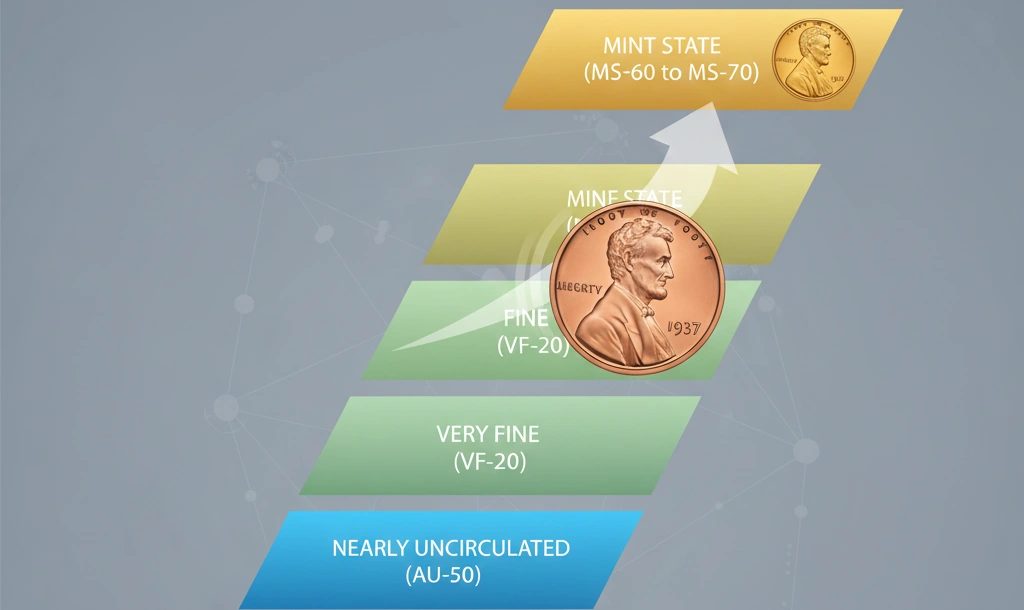
The market 1937 penny value depends directly on quantitative and qualitative indicators of surface wear determined by the 70-point Sheldon scale.
This coin, struck with a total mintage exceeding 394 million specimens, demonstrates extreme price volatility when moving from mid-range grades to the highest preservation categories.
Analysis of auction data confirms that physical defects arising during circulation or improper storage reduce the asset value by 90–98% relative to reference specimens.
For an objective assessment of the 1937 coins' value, numismatists use standardized categories describing the degree of relief and field preservation.
Circulated Coin Categories
Good (G-4): The coin possesses significant wear, preserving only the basic contours of Lincoln's portrait and the wheat ears.
Very Fine (VF-20): Details of the president's hair and lines on the ears remain discernible, having flat areas from prolonged friction.
Extremely Fine (EF-40): Wear is minimal, affecting only the highest points of the relief such as Lincoln's cheekbone and the upper grains of the ears.
Uncirculated Coin Categories
The Mint State (MS) condition is characterized by a complete absence of wear marks obtained during trade turnover.
MS-63: The presence of moderate nicks and scratches on the coin field arising during bag transportation is allowed.
MS-65: Considered an "investment" level, possessing a bright mint luster and minimal surface defects.
MS-67: Characterized by exceptional die strike clarity, preserving a practically ideal surface state.
MS-68: Representing the maximum achievable grade for this issue, being encountered extremely rarely due to the softness of the copper alloy.
Role of Color Gradation in Copper Alloy Assessment
Copper, being a chemically active metal, changes its color under the influence of oxygen and moisture, reflecting directly on the final price of the 1937 penny.
Grading services like the free coin identifier app distinguish three primary color categories.
Color Category | Description | Estimated Value (USD) |
Red (RD) | Preservation of >95% original red luster | 30.00 — 45.00 |
Red-Brown (RB) | Presence of 5% to 95% red color on a brown background | 12.00 — 18.00 |
Brown (BN) | Practically complete absence of original luster | 3.00 — 7.00 |
Statistics show that the absence of red color reduces the value of a coin in MS-65 condition by 4–6 times.
Price Change upon Grade Shift
The value progression of the 1937 penny is non-linear, demonstrating sharp jumps upon reaching the highest preservation indicators.
Price Dynamics for Philadelphia Mint Coins (RD)
MS-63 RD: 10.00 USD.
MS-65 RD: 45.00 USD.
MS-66 RD: 110.00 USD.
MS-67 RD: 350.00 USD.
MS-68 RD: 6,500.00 USD.
The difference in price between MS-67 and MS-68 exceeds 1700%, reflecting an acute supply shortage in the premium segment.
Statistics of Auction Records and Preservation
Record sales confirm the theorem that exceptional preservation is the primary driver of price, ignoring mintage volume.
1937-D MS-68 RD (PCGS): Sold in 2014 for 14,100 USD, being one of the few confirmed specimens in such a grade.
1937-S MS-67+ RD (PCGS): Realized for 5,875 USD, demonstrating a premium for the presence of the "+" sign (intermediate quality assessment).
1937 (P) MS-68 RD (PCGS): Reached a price of 7,200 USD at a Heritage Auctions sale.
Annual price growth for specimens in MS-67 RD grade and higher averages 7.5% over the last 10 years, outperforming inflation rates.
Surface Degradation Factors and Value Loss
Grade reduction occurs due to the impact of mechanical and chemical factors accumulated over 88 years of the coin's existence.
Mechanical Damage
Contact Marks: Appearing as a result of coins colliding with each other, leaving micro-dents on the portrait.
Hairlines: Arising from attempts to clean the coin with abrasive fabrics, irretrievably destroying the mint luster.
Carbon Spots: Black dots forming due to microscopic contaminants on the blank before striking.
Chemical Corrosion
The patination process, turning a red coin into a brown one, is natural, yet the presence of "greenery" (active corrosion) nullifies collective value.
Storage in PVC albums causes the appearance of a sticky residue, corroding the metal surface and moving the coin into the "Details" category (unsuitable for numeric grading).
The production site affects striking quality standards, determining the probability of finding a coin in high preservation.
Mint | 1937 Striking Features | MS-67+ Grade Chance |
Philadelphia | Sharp strike, large number of surviving MS specimens | High |
Denver | Frequent die wear observed, leading to blurred details | Low |
San Francisco | Characterized by high-quality blank preparation and bright luster | Medium |
Denver (D) coins in MS-68 condition are valued higher than Philadelphia ones due to technological production challenges during that period.
Percentage Ratio of Grade Survivability
Based on PCGS Population Report data, a statistical picture of surviving coin distribution can be compiled.
Below MS-60: >99.4% of the total number of existing coins.
MS-60 — MS-65: ~0.5%.
MS-66 — MS-67: ~0.09%.
MS-68 and higher: <0.001%.
This distribution explains the exponential price growth caused by supply shortages amidst stable demand from investors.
Proof Technology and Its Impact on Price
In 1937, only 9,320 mirror specimens (Proof) were struck for collectors.
The condition of Proof coins is assessed by the PR (Proof) scale, where the presence of the Cameo effect (contrast between frosted relief and mirror field) increases the price by 3–5 times.
PR-65 RD: 250 USD.
PR-67 RD: 950 USD.
PR-67 Cameo: 4,500 USD.
The absence of scratches on the mirror field is a critical factor, as any defect on such a surface is more noticeable than on regular coins.

Professional Condition Assessment Methodology
To determine the exact condition, algorithms excluding subjective perception are used.
Inspection under a 60-75 W lamp using a coin checker app to search for micro-scratches.
Checking by rotating the coin under light to detect the "Cartwheel effect," confirming the presence of original luster.
Comparing the clarity of letters in the word LIBERTY and the date with reference samples from the mint.
Analysis of letter edges for smoothness, indicating a weak strike or wear.
Value Change Forecast Depending on Grade
Relying on historical trends, one can predict further price behavior for various preservation categories by 2035.
BN/RB Categories (Circulated): Growth will not exceed 1–2% per year, corresponding to currency devaluation rates.
MS-65 RD Category: A stable increase of 3–4% annually is expected due to the reduction of the "red" coin fund.
MS-67+ RD Category: Growth of up to 10–12% per year is possible due to these assets transitioning into the museum rarity category.
Impact of Certification on Asset Liquidity
A 1937 coin lacking a confirmed grade from an authoritative organization trades at a discount of 30–50% from the market price.
The risk of purchasing a counterfeit or a coin with artificially restored color forces buyers to ignore uncertified lots in the high-price segment.
The presence of a slab (hermetic capsule) fixes the coin's condition at the moment of assessment, preventing further copper oxidation.
Minting Errors as a Condition Modifier
Some defects permitted by the mint can increase the coin's value even with signs of wear.
Lamination Error: Metal peeling, reducing the grade but adding an error premium of 10–20 USD.
Die Crack: A raised line on the surface indicating intensive equipment operation.
In 1937, no major errors such as Double Die were recorded, leaving the primary value tied to surface purity.
Conclusion
Analysis shows that the 1937 wheat cent is a clear example of how physical preservation dominates historical significance or mintage volume.
Minimal changes in surface condition, barely discernible without special equipment, move a coin from the scrap metal category into the rank of highly liquid investment tools.
Adherence to storage conditions and timely certification are key factors for preserving and increasing the value of this numismatic object.
Studying market dynamics confirms the feasibility of acquiring exclusively specimens in grades above MS-66 RD for long-term portfolio formation.